

How much does a baby sleep month by month? 0-12 month guide
“Sleeping like a baby” is one of the more misleading phrases in the language. Babies, especially in the first months, sleep a lot but also wake up a lot. A newborn may need 14 to 17 hours of sleep a day, and by 12 months that drops to about 11 to 14 hours split between night sleep and one or two naps. In between those numbers is a journey that shifts almost every month.
This guide gives you a sense of how much a baby usually sleeps at each stage of the first year, how naps and nighttime sleep are distributed, and what changes to expect. The goal isn’t to compare your baby to an ideal table; it’s to give you a map to find your bearings.
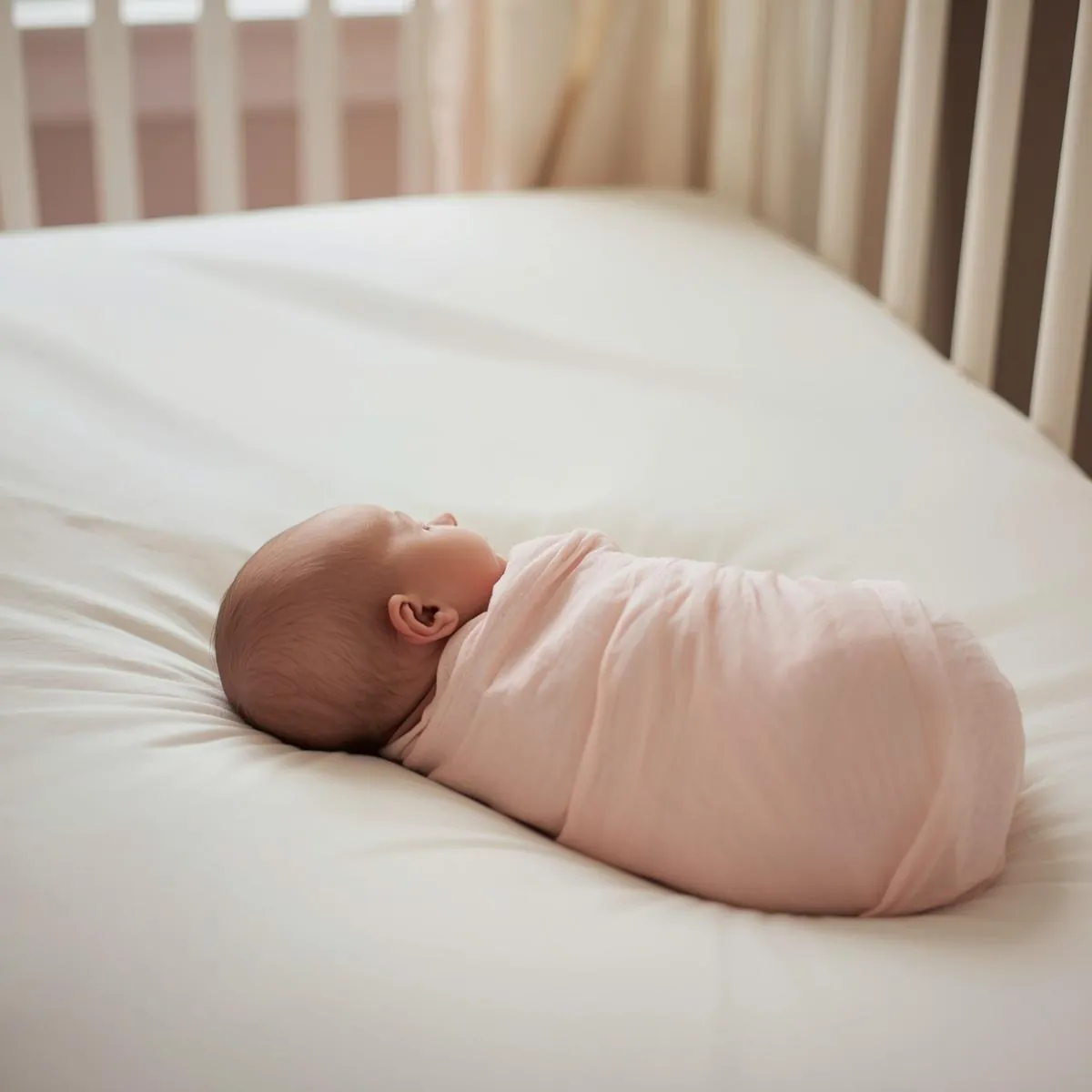
How much does a baby sleep by month
These are the orienting ranges of total sleep in 24 hours, based on the consensus of the American Academy of Sleep Medicine (AASM, 2016) and the guidelines of the American Academy of Pediatrics (AAP, 2022). They’re broad averages: within the range, your baby may be at the high end, low end, or in the middle, and be perfectly fine.
| Age | Total sleep / 24 h | Nighttime sleep | Naps per day |
|---|---|---|---|
| 0-1 month | 14-17 h | 8-9 h (with frequent wake-ups) | 4-6 short |
| 1-3 months | 14-16 h | 8-10 h | 3-5 |
| 3-4 months | 13-15 h | 9-11 h | 3-4 |
| 4-6 months | 12-15 h | 10-11 h | 2-3 |
| 6-9 months | 12-14 h | 10-12 h | 2 |
| 9-12 months | 11-14 h | 10-12 h | 1-2 |
ℹ️Ranges orient, they don't grade
If your baby sleeps an hour less or an hour more than the range, that’s not a problem in itself. What matters is that they’re active and calm when awake, eating well, and growing. The ideal amount of sleep varies between babies the same way it varies between adults.
Month by month: what to expect
0-1 month
The newborn doesn’t tell day from night, and sleep is split into short cycles of 2-4 hours around the clock. Each sleep stretch is brief because they need to eat often (between 8 and 12 times a day, as we explain in How often does a newborn eat?).
There’s no possible routine yet, and forcing one is wasted energy. This stage is lived in “now sleep, now eat” mode.
1-3 months
The day-and-night distinction starts to peek through. Some babies make longer stretches in the early morning (4 or 5 hours in a row), although wake-ups are still common. Daytime naps are short, frequent, and irregular.
3-4 months
Here comes the famous 4-month change. The baby’s sleep matures and starts to look more like an adult’s, with cycles that include lighter phases. The practical result: many babies who used to do longer stretches start waking more often for a few weeks. It’s a developmental milestone, not a real regression.
4-6 months
Sleep starts to organize. More structured naps appear (usually 3, sometimes 2), and the nighttime stretch tends to consolidate to 10-11 hours with one or two wake-ups. Many babies can do continuous 5-6 hour stretches at night, but it’s not universal.
6-9 months
Two naps a day consolidate (mid-morning and early afternoon), and most babies are now in a long nighttime stretch, although short wake-ups are still normal, especially during teething or developmental milestones like sitting up or crawling.
9-12 months
Around 9-10 months, many families notice the afternoon nap getting shorter. Between 12 and 18 months, the transition to a single nap a day is common, although some babies make the switch earlier and others later. At night, expect 10-12 hours with the occasional wake-up.
Memobebe helps you remember everything
Try for freeHow long does a “normal” nap last?
It depends on age and on the baby. As an orientation:
- 0-3 months: highly variable naps, from 30 minutes to 2-3 hours.
- 3-6 months: naps between 30 minutes and 1.5-2 hours. Many babies do one short nap (30-45 min) and one longer one.
- 6-12 months: naps from 45 minutes to 2 hours. The two daily naps usually total 2-3 hours.
Short naps (30-45 min) are normal in young babies, especially before 6 months. They’re not a problem to fix; they’re part of development.
Waking at night is still normal
One of the most widespread myths of the first year is that “by 6 months they should sleep through the night.” Reality is different: a large cohort study published in J Dev Behav Pediatr (Hysing et al., 2014) confirms that waking at least once at night is still common at 12 months, and that falls within the normal physiological range.
Brief wake-ups are part of human sleep at any age. The difference is that adults fall back asleep without telling anyone, and babies, especially the youngest ones, look for us.
How to see your baby’s real sleep pattern
When you’re parenting on broken sleep, perception lies. Nights that feel endless sometimes have only two wake-ups, and entire weeks blur together in memory. Seeing the real pattern means logging it.
With Memobebe you can tap to log the start and end of each sleep stretch (nap and night). The app keeps your day’s record with the time and duration of each sleep, and shows how long has passed since the last time they fell asleep. Having that information at hand, in the moment, lifts a lot of mental load.
We use the same approach for other parts of daily care: we cover it in How to track your baby without losing your mind.
Habits that help baby sleep
Without promising sleep through the night (no magic formula exists), these habits have enough evidence to be worth recommending:
- Tell day from night from the start: during the day, natural light, normal household activity. At night, low light, quiet, minimal interaction during wake-ups.
- A short bedtime routine: bath, cuddles, song, dim light. It doesn’t need to last 40 minutes; 15-20 consistent minutes is enough.
- Put the baby down drowsy but still awake: when possible. It often isn’t, and there’s nothing wrong if they fall asleep in your arms or at the breast.
- Room temperature between 18-20 °C (64-68 °F).
- Sleep position: always on their back until age one, on a firm surface, with no pillows, cushions, or stuffed animals, per the AAP’s official recommendations (updated in 2022).
💡There's no single right method
Co-sleeping, crib in your room, crib in their own room, nursing to sleep, strict routine, gentle routine: there are happy families with each option. Pick what works in your context and don’t feel bad if it doesn’t match what your local mom group recommends.
Frequently asked questions
When do babies sleep through the night?
There’s no exact date. Some babies do long stretches (6-8 hours) from 3 months; others keep regular wake-ups well past their first year. Both scenarios are normal and say nothing about how your baby will sleep when they’re older.
They sleep a lot: should I worry?
If your baby sleeps within the range for their age (see table), or even one or two hours more, and is active and feeding well when awake, that’s usually just their rhythm. Mention it to your pediatrician at the next routine visit if it gives you doubts, without urgency.
They sleep little: should I worry?
Some babies need less sleep. If they’re at the low end of the range but growing well and in a good mood when awake, that’s likely their pattern. If you notice constant fussiness, difficulty settling, or fragmented sleep, that’s a good topic for your routine pediatric visit.
What are sleep “regressions”?
They’re specific stages (4 months, 8-10 months, 12 months, 18 months) when the baby’s sleep gets worse for two or three weeks, almost always coinciding with a developmental milestone. They pass on their own. They don’t require drastic changes: keep the routine and wait.
Do long daytime naps prevent sleeping at night?
In general, no. Babies who get age-appropriate naps tend to sleep equally well or better at night, because they reach bedtime less overtired. The “too tired to sleep” effect is real in babies.
A baby’s sleep changes practically every month during the first year, and what works at 2 months doesn’t work at 8. Instead of looking for the definitive method, it’s worth observing your baby’s pattern and adjusting on the fly. Keeping a simple log with an app like Memobebe gives you that snapshot without having to strain to remember each stretch of the night.
Find more content on baby care in our baby section.
Related articles
How baby sleep changes during molar teething
Tooth-by-tooth timeline, how long each one lasts, and how to tell molar wake-ups apart from a sleep regression or another cause.
No-cook summer meals for pregnancy
7 no-cook summer meals for pregnancy: fresh, listeria-safe, and built for the hottest days when the oven stays off.
Anti-gas dinners in the third trimester of pregnancy
6 gentle dinners to ease gas and bloating in late pregnancy: what to avoid, how to combine, and why onion and unpeeled legumes don't help.